Document Tagging & Categorization — EDMSNext
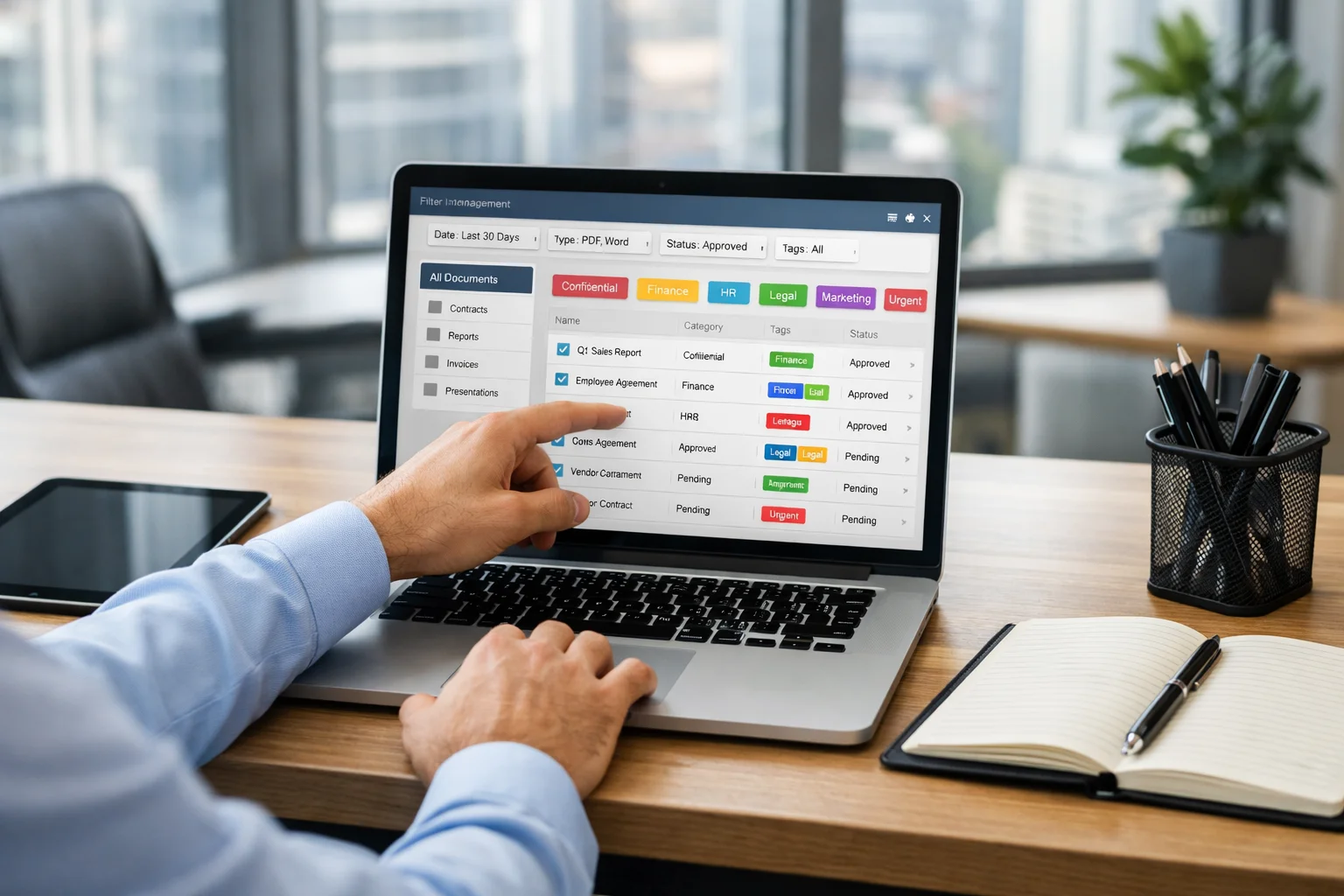
Document tagging and categorization is the process of organizing documents using tags, labels, and predefined categories so users can quickly locate and manage files. The EDMSNext Document Tagging & Categorization System allows organizations to classify documents using intelligent tagging and structured categories, improving document search and organization.
Organizations manage thousands of documents every day, including contracts, reports, policies, engineering drawings, and compliance records. However, when documents are stored without clear classification, employees often struggle to locate the correct files.
Therefore, organizations implement document tagging and categorization systems to organize documents effectively. By assigning tags and categories, teams can classify documents based on type, department, project, or keywords.
The EDMSNext Document Tagging & Categorization System helps organizations organize their document repositories while improving document retrieval and collaboration.
If you want to explore more capabilities of enterprise document management platforms, visit our guide on top document management software features.
Why Document Tagging & Categorization Are Important
When organizations store documents without clear categorization, finding the right file becomes time-consuming. As a result, employees spend unnecessary time searching for documents.
Document tagging and categorization solve this problem by organizing documents using descriptive labels and structured categories.
- First, tagging improves document searchability
- Next, categories organize documents systematically
- In addition, tags help classify documents by project or department
- Furthermore, structured categories improve document management
- Finally, organizations maintain organized document repositories
Many industries rely on document categorization systems to manage complex documentation structures. You can explore sector-specific implementations on our industry solutions page.
How the EDMSNext Document Tagging & Categorization System Works
The EDMSNext platform allows organizations to classify documents using customizable tags and structured categories. As a result, documents remain organized and searchable.
Document Upload or Creation
First, users upload or create documents within the EDMSNext system.
Tag Assignment
Next, users assign descriptive tags such as project name, department, document type, or keywords.
Category Classification
The system organizes documents within predefined categories such as contracts, reports, policies, or compliance files.
Document Indexing
After tagging and categorization, the platform indexes documents so they become searchable.
Advanced Search and Filtering
Finally, users can locate documents quickly by filtering results based on tags or categories.
To understand how organizations implement document workflows, explore our document management use cases.
Key Features of EDMSNext Document Tagging & Categorization
Custom Document Tags
Organizations can define custom tags to classify documents according to their operational needs.
Structured Category Management
Documents remain organized within predefined category structures.
Advanced Search and Filtering
Users can search documents using tags, keywords, or category filters.
Automated Document Classification
The system supports automated tagging based on predefined document classification rules.
Integration with Document Workflows
Tags and categories integrate with document review, approval, and lifecycle workflows.
Industries That Use Document Tagging Systems
Document tagging and categorization systems are widely used by industries that manage large volumes of digital documentation.
- Pharmaceutical and life sciences organizations
- Healthcare providers and hospitals
- Manufacturing companies
- Engineering and construction firms
- Financial and legal institutions
EDMSNext supports organizations across multiple regions. Explore our service coverage through our locations pages.
Document Tagging vs Traditional Folder Organization
- First, traditional systems rely on folder hierarchies
- However, tagging systems classify documents using descriptive labels
- As a result, documents become easier to locate
- In addition, tagging allows flexible document classification
- Therefore, organizations maintain better document organization
Summary: Document tagging and categorization help organizations organize and retrieve documents efficiently. EDMSNext allows teams to assign tags and categories to documents, improving document search, classification, and collaboration.
Why Organizations Choose EDMSNext
Modern organizations require powerful document classification tools to manage growing document repositories. Therefore, many enterprises choose EDMSNext to improve document organization.
- Custom document tagging and categorization
- Advanced enterprise document search
- Centralized document repository
- Integration with document workflows
- Scalable enterprise document management platform
Learn more about our platform on our about us page.
Frequently Asked Questions
What is document tagging?
Document tagging is the process of assigning descriptive labels or keywords to documents so they can be easily categorized and searched.
Why is document categorization important?
Document categorization helps organizations organize files systematically and makes it easier to locate documents.
How does EDMSNext manage document tagging?
EDMSNext allows users to assign tags and categories to documents, improving classification and document retrieval.
Which industries use document tagging systems?
Industries such as healthcare, pharmaceuticals, manufacturing, engineering, and finance rely on document tagging systems to manage documentation.
Can tagging improve document search?
Yes, tagging improves document search by allowing users to locate files using keywords, tags, or document categories.
Get Started with EDMSNext
You can read more document management insights on our blog.
If you want to see how EDMSNext can improve document organization and classification, you can book a demo or contact our team.
Follow EDMSNext for enterprise document management insights on LinkedIn.

